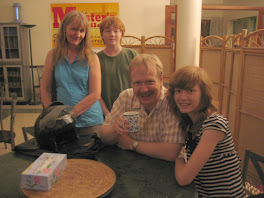
Yesterday afternoon, Shirley, Mary and I met at MMC in order to take a few photographs of the centre and the counselling service in particular. The photograph above shows Shirley and Mary by the MMC plaque, and those below the entrance to the new counselling room, the two comfy airm armchairs, and Shirley at the desk.
Saturday, April 24, 2010
Mercy Medical Centre
Yesterday afternoon, Shirley, Mary and I met at MMC in order to take a few photographs of the centre and the counselling service in particular. The photograph above shows Shirley and Mary by the MMC plaque, and those below the entrance to the new counselling room, the two comfy airm armchairs, and Shirley at the desk.
Monday, March 8, 2010
Hope International School
Whilst both Lisa and Martin attended Northbridge International School (NISC) during our first term in Cambodia (2001-2005), they moved over to Hope International School from 2006. Lisa studied there for three years (Year 9-11) before heading back to England to study for AS-levels at The Sixth Form College, Colchester. Martin continues at Hope, however, and having completed Year 6-8, is currently in Year 9.Hope has a strong Christian family ethos, and the curriculum is a Commonwealth one, leading to IGCSEs and AS-levels under Cambridge International Examinations (CIE). The school was only in its infancy during our first term, but by the time we returned from Home Assignment in 2006, it had become the clear choice for us as a family. Several OMF families made similar decisions around that time, and OMF children now make up some 10% of the school!
One of the strong distinctives of Hope is its aim to provide affordable schooling for Christian workers in Cambodia. To maintain this the Board comprises (alongside the Director, teacher and Parent Council representatives), representatives from the member missions who are committed to the school. Amongst these is OMF, and I have served as the OMF representative on the Board since December 2007. I am currently Vice Chair of the overall Board, as well as acting as Appeals Member, and chairing the Personnel Committee.
The picture above shows the main entrance of Hope (with some Sinclairs in a tuk tuk outside), and those below, Brent Willsmore (the Director), a Year 11 science class (with Lisa hidden in their midst), and the dining area.


Thursday, November 19, 2009
The Killing Fields of Choeung Ek
Although we went to see the Tuol Sleng Genocide Museum fairly early in our time in Cambodia, somehow that seemed enough horror for us. We only finally made a visit to the killing fields of Choeung Ek in 2008. This is where the 17,000 prisoners of Security Prison 21 (S-21) were taken to be buried. Some died under interrogation and torture, some died at Choeung Ek immediately before burial, some were buried alive. A little over half the thousands of bodies have been exhumed from the mass graves, and the skulls placed in a glass windowed stupa, with the remaining bones housed in the roof. Part of the site is now under water, and so the graves in that section have never been opened.
For some visitors, as they walk around the many, many mass graves (now not so deep due to the earth being washed back in over the years), with the soil surface still littered with scraps of clothing from the victims, the horror seems greater than that of the prison. For me, somehow, the deaths at Choeung Ek seem almost merciful following the terrible torture of Tuol Sleng, as the prisoners desperately tried to satisfy their interogators and so bring an end to their suffering in death. Either way, both sites are an horrific reminder of just how near unspeakable cruelty and genocide can be.The final three pictures show some juvenile skulls in the stupa; a tree near the mass graves with the caption 'Killing tree against which executioners beat children'; and a plaque describing some of the terrible details of burial.


Tuesday, November 10, 2009
Koh Kong
Last week was the Khmer Water Festival (Bon Om Duuk), and Shirley, Martin and I took the opportunity for a week's holiday in Koh Kong. The town is a provincial capital, but it is very close to the Thai border, and is becoming popular as an entry point to/from Cambodia, as well as for 'visa runs', where expatriots in either Thailand or Cambodia cross the border and back just to get their visa renewed.
We stayed at the Apex Hotel, which proved to be good value for money ($15 per night, extra for breakfast), but the hotel had some of the usual eccentricities! The hotel is only about a year old, but the plumbing is already in trouble. In one of our rooms, whenever you used the pedestal basin in the bathroom, about half the water contents simply flowed out onto the floor (and your feet and trouser legs)! The hotel was very full, and this caused two problems of note. Most (all?) rooms had DVD players - we had spotted this on the website, and so taken some with us to watch - but only some had the essential remote controls. The hotel staff said that when the hotel was not so busy, they took them from empty rooms, for guests who wanted them. As the hotel was busy this week though, we would have only one control between our two rooms! Somehow, it didn't seem to strike them as a situation that required any more action than this. A more irritating problem though was the electricity - for three evenings, the hotel was so full that the electricity kept overloading, throwing the circuit breaker in reception. The whole hotel would be plunged into darkness, but the desk clerk would calmly walk over, throw the circuit breaker back in, and go back to his desk. For a few hours each evening, the power went off for 30 secs every five minutes! This, of course, made it impossible to watch a DVD - you could not wind back to the point you were at before the power went off again. We discovered, however, that reading a book with a torch to hand was still possible. Anyway, the restaurant was good value, there is a swimming pool, it is conveniently located, and the hotel's eccentricities are by no means unusual in Cambodia!
On an entirely positive note, we found a lovely restaurant, Fat Sam's, on the main street. This is owned and run by a Welsh man (Sam of the title) and his Cambodian wife. They have tracked down and serve high-quality and affordable British cooking, such as we hardly ever find in Cambodia. Delights included battered fish and chips, steak pie and chips, cumberland sausage and chips, baked potatoes, apple & blueberry pie and custard, and apple & rasberry crumble and custard. The owners and staff made everyone very welcome, and we met quite a few Brits over meals there, entertaining one another with travelling tales, and receiving tourist information from Sam as well.
Although most of our week was sleeping, watching DVDs, reading, using the internet cafe and visiting the restaurants of Koh Kong, we did manage one trip out to a nearby mangrove swamp, which has had access walkways installed to allow visitors to go right into the forest with ease. At the end of the walkway is a pedestrian suspension bridge, and from there it is possible, as we did, to take a boat trip out to nearby sandy island. Although some people showed us photos of snakes they had taken under the branches, the Sinclair party proved far too focused on not falling off the walkway to spot all the available wildlfe. However, the trees proved slow moving enough to get on film.Altogether, it was a very enjoyable week, and we look forward to doing more of the potential Koh Kong day trips on future visits.

Saturday, October 24, 2009
Toul Sleng
These photos were taken on a harrowing visit in 2002 to the Tuol Sleng Genocide Museum, which is housed in what was Security Prison 21 (S-21), a former high school that was converted into an interrogation and torture centre by the Khmer Rouge. During 1975-79, more than 17,000 people held at S-21 were subsequently executed there or at the Killing Fields of Choeung Ek. One of the most striking aspects of the museum is that it shows genocide 'on the cheap'. The high school looks as if little more than a week's effort was made to convert it into a torture centre, with the torture implements themselves simple household items or gym equipment from the school. Intentionally, we have not been to the museum many times, even though everyone who visits Cambodia should see it, because it is so distressing. We finally took Martin in 2008, as it seemed time for him to see with his own eyes what we had only talked about before, and he was willing to see it; Lisa has yet to go.The pictures show the prisoners' security regulations; a torture room (with a photograph of the last vistim on the wall); the faces of the dead; the function of Building 'C'; some of the cells; and a view through the barbed wire into the courtyard.


Tuesday, October 13, 2009
Transitions

Today's post is a guest one by Lisa, illustrated by a Skype screenshot!
"After spending almost half of my life as a missionary kid in Cambodia, making the transition back to life in England and the Western world has certainly been something of an adventure for me. Despite only having been back for a month, I have already been through what has felt like a rollercoaster of emotion. Saying goodbye to my family for the year was a low point, but since then I have had so many high points – laughing until I cried with the [host family's] girls, having endless bubble baths and glasses of fresh, English milk, chatting away happily with my family over Skype and seeing old friends again, to name a few. My first trip to Tesco filled me with amazement – I had almost forgotten the abundance of lovely food here in England, and couldn’t wait to help myself to sausage rolls, nectarines and all the other silly little things I missed so much living in Cambodia. The truth is that at first, even the thought of doing something as ordinary as getting the bus filled me with anxiety – what was I supposed to say? What if I couldn’t find the right change, or ended up in Greenstead, or even violated some unspoken code of conduct that all ordinary English people knew?
Since then, however, I feel like I have really settled into life here in England with [my host] family. I can now be seen each morning catching the bus in to town like any other English college student, but I know that I’ll never forget the time I spent in Cambodia – it will always be a part of me. You might even say that a little piece of my heart is still there, across all the oceans that lie between us."
Friday, October 9, 2009
So What About Martin?
While his sister, Lisa, has gone back to the UK to study, Martin (14) continues here in Cambodia, having just started his fourth year at Hope International School. He is in Year 9, the last year before the start of two year's formal preparation for IGCSEs (an English school exam, usually taken at age 16). Hope is an exam centre for Cambridge International Examaminations (CIE), offering IGCSEs and subsequently AS levels, although not A2s, as yet. Martin enjoys reading, and often reads when others might socialise! The photo above shows him waiting in a tuk tuk outside Hope school, deep in a book. He is also keen on computer games, and whilst he has now stopped playing EvE Online (mainly due to the monthly subscription charge), he has returned to Guild Wars, another massive multiplayer online game, as well as playing a variety of single-player games. Martin is a difficult chap to photograph, always trying to avoid the camera, but I've included three below. The first shows him looking rather hot, drinking a cup of tea (or coffee) from his favourite mug; one in an orchid garden in Kuala Lumpur, Malaysia late 2007; and the final one with his sister in Prajuap, Thailand in July.

Subscribe to:
Posts (Atom)